

Coreform Cubit provided an efficient environment for constructing complex 3D fault geometries and generating the triangulated meshes needed for our earthquake simulations. Without Cubit’s geometric flexibility and direct .stl export, it would be much harder to preserve the structural complexity required in our models.
Paula Herrero-Barbero, Geoscience Researcher
GEOSMART (IGME-CSIC)
Background
Researchers in GEOSMART at the Geological and Mining Institute of Spain (IGME-CSIC), part of the Geological Hazards and Climate Change Department, study active geological processes using modeling, artificial intelligence, and remote sensing. One of the group’s research lines focuses on earthquake physics and seismic hazard in active fault systems. Their work aims to better understand how fault geometry and structural complexity influence earthquake nucleation, rupture propagation, and long-term seismic behavior. The broader goal is to generate scientific knowledge and practical tools related to active geological processes, while providing society with accessible, up-to-date information that supports disaster prevention and risk reduction.
Because earthquakes unfold over long time scales and at depths that cannot be directly observed, numerical simulation is an essential tool in this field. Physics-based seismic cycle simulations help researchers investigate how stress accumulates on faults and how ruptures propagate during earthquakes. These simulations require realistic three-dimensional fault geometries that capture the complexity observed in nature.
Within this workflow, building accurate 3D fault models and generating suitable computational meshes is a critical step. These geometries serve as input for specialized numerical solvers that simulate earthquake rupture dynamics and long-term seismic cycles.
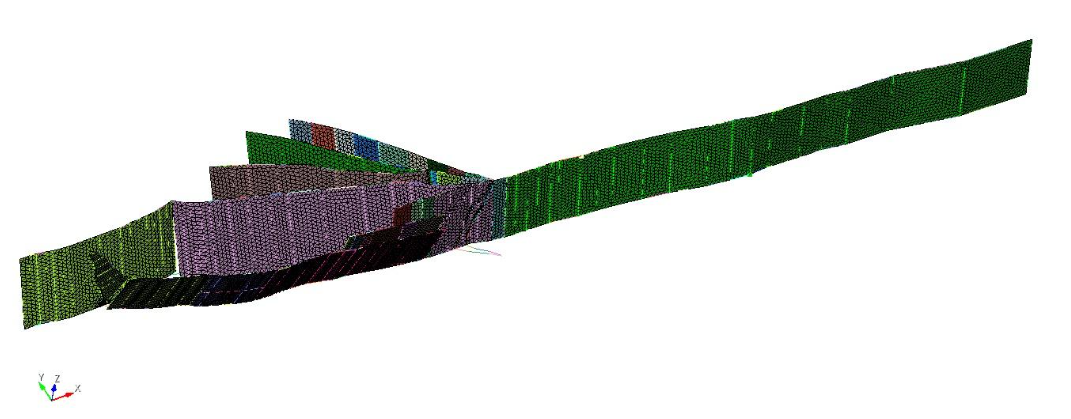
Figure 1: Three-dimensional model of the El Salvador Fault System down to a depth of 9 km. This geometry serves as the structural basis for physics-based earthquake simulations
Problem
Physics-based earthquake simulations require realistic three-dimensional representations of fault surfaces together with computational meshes that can be used directly by numerical solvers. Building these geometries is challenging because natural fault systems are structurally complex, often consisting of multiple interacting fault segments with irregular shapes and variable orientations.
Another challenge in this workflow is generating the specific type of triangulation required for downstream modeling. Some meshing tools cannot produce the needed triangulation, and not all of them export cleanly in .stl format, even when that format is required by the simulation code. As a result, preparing meshes that are both geologically realistic and fully compatible with the numerical workflow can become a significant bottleneck.
Solution
Coreform Cubit provided an efficient environment for constructing complex 3D fault geometries and generating the triangulated meshes required for earthquake simulations. In this workflow, direct export to .stl was especially important because the simulation code requires that format. Cubit also offered the geometric flexibility needed to represent structurally complex fault systems while producing meshes suitable for downstream numerical modeling.
Compared with other tools commonly used in structural geology, Cubit was better suited to the meshing requirements of this project. While those tools can be effective for building geological models, they do not always produce the type of triangulation needed for this simulation workflow, and they may not export cleanly in the required formats. Cubit also improved the efficiency and reliability of model preparation. Cubit’s combination of reliable mesh generation, geometric control, and straightforward export made it the most suitable option for preparing these models.
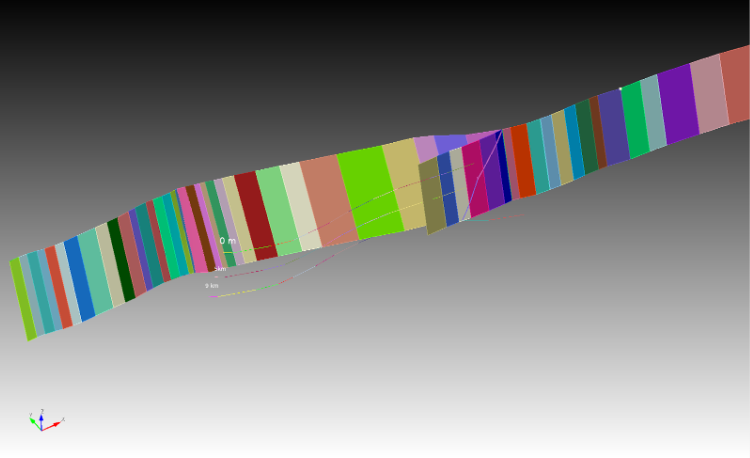
Figure 2: Example of the construction of fault surfaces from mapped surface fault traces in Coreform Cubit.
The workflow begins by defining fault traces at the surface and importing them into Coreform Cubit as lines with geographic coordinates. Cubit is then used to construct three-dimensional fault surfaces and generate triangulated meshes that represent the fault system at different resolutions. These meshes are exported in .stl format and used as input for physics-based earthquake simulation codes.
The resulting simulations provide insight into how complex fault geometries influence earthquake behavior. The geometries and meshes generated in Cubit are therefore a critical part of the modeling workflow, making it possible to incorporate realistic fault structures into the simulations.
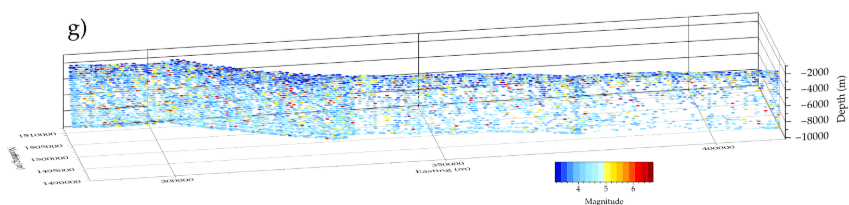
Figure 3: Example of the synthetic seismicity distribution obtained from seismic cycle simulations using the simpler fault-system model.
Conclusion
Coreform Cubit played a key role in constructing and meshing the complex 3D fault geometries required for the physics-based earthquake simulations used in this project. By providing a reliable way to generate high-quality triangulated meshes and export them in formats compatible with the simulation codes, Cubit streamlined model preparation and made it possible to incorporate realistic fault structures into the simulations.
This capability supports investigation of how fault geometry and structural complexity influence earthquake behavior in a crustal region of Central America.