
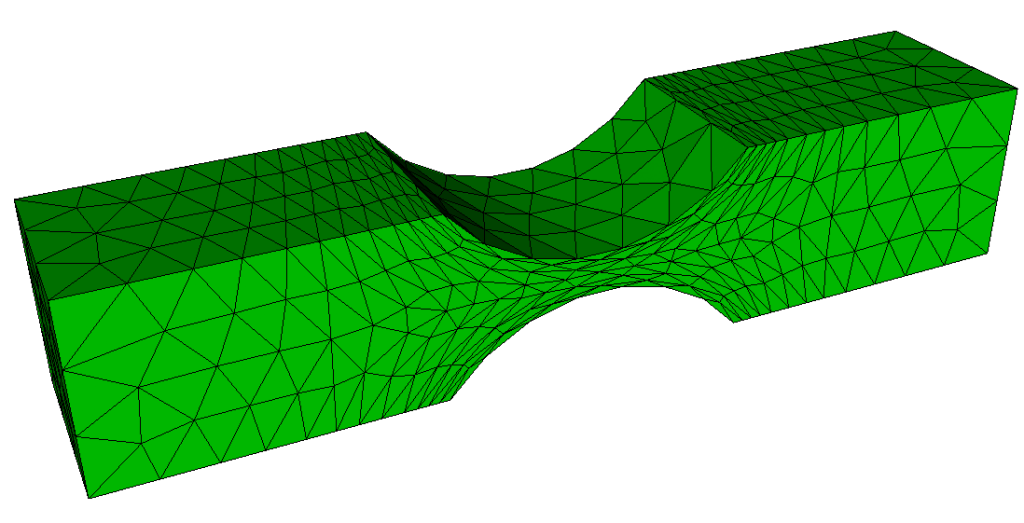
June 2026 - Coreform announces Coreform Cubit 2026.6 release: including advanced meshing, improved robustness, and expanded solver interoperability.
Coreform is pleased to announce the release of Coreform Cubit 2026.6, the latest version of our advanced meshing software for simulation-driven engineering workflows.
This release delivers meaningful improvements across meshing, geometry preparation, import/export workflows, visualization, scripting, and machine learning support. Highlights include new anisotropic tetrahedral meshing, cohesive element generation for crack and interface modeling, more robust triangle and tetrahedral meshing, improved mesh quality metrics for higher-order elements, reduced memory usage in Sculpt refinement, and expanded file compatibility for solver workflows.
What’s new in Coreform Cubit 2026.6
Coreform Cubit 2026.6 is focused on helping users generate higher-quality meshes, work more reliably with complex geometry, and move models more efficiently between Cubit and downstream simulation tools.
For users working with advanced fracture and interface problems, this release introduces cohesive element generation and anisotropic tetrahedral meshing. For users preparing large or complex models, improvements to triangle and tetrahedral meshing robustness, composite surface handling, assembly file opening, and Sculpt refinement performance help streamline day-to-day workflows. The release also includes expanded import/export capabilities, including more robust MCNP import for nuclear users working with radiation transport models.
Major updates include
- New advanced meshing capabilities — Coreform Cubit 2026.6 introduces anisotropic tetrahedral meshing and cohesive element generation, supporting more specialized workflows such as crack modeling and cohesive interface modeling.
- Improved mesh robustness and quality assessment — Triangle and tetrahedral meshing have been improved for better stability and mesh quality, with additional accuracy improvements for mesh quality metrics and new Jacobian and scaled Jacobian metrics for Tetra10 and Tri6 higher-order elements.
- Better performance for large and complex models — Parallel Sculpt refinement now uses significantly less memory, helping large models run on HPC nodes that previously ran out of memory, and Cubit files containing assembly data now open faster.
- Expanded solver and file compatibility — Updates include 64-bit Exodus ID support, additional Abaqus import support, solver element mapping, improved degenerate-element handling, I-DEAS sideset import, and more robust MCNP import for nuclear users who need reliable pathways from radiation transport geometry into Cubit workflows.
- Updated usability, scripting, and ML support — The GUI includes improved dark mode support and updated icons, the journal editor adds new script execution shortcuts, Cubit now includes Python 3.12, and new graph neural network feature strategies expand machine learning support through the Cubit Python API.
Join the Coreform Cubit 2026.6 release webinar
Want a closer look at what’s new?
Join us for a live webinar where the Coreform team will walk through the Coreform Cubit 2026.6 release highlights, demonstrate key updates, and discuss how these improvements can support your meshing and simulation workflows.
Coreform Cubit 2026.6 Release Webinar
Date: June 17
Time: 9:00 a.m. Mountain Time