

“Coreform Cubit gives us a single, scripting‑driven environment to build complex subduction‑zone geometry, generate high‑quality meshes for elastic and viscoelastic simulations, and automate large suites of parameterized 2D and 3D models. This makes our earthquake‑cycle studies both efficient and reproducible.”
Xialong Zhang
The Earthquake Cycle Deformation and Seismogenic Mechanisms Group
Institute of Geology and Geophysics, Chinese Academy of Sciences
Background
The Earthquake Cycle Deformation and Seismogenic Mechanisms Group at the Institute of Geology and Geophysics, Chinese Academy of Sciences (IGGCAS), investigates the mechanical behavior of subduction zones using finite‑element modeling. Their work focuses on earthquake‑cycle deformation, crust–mantle rheology, and the physical processes governing megathrust earthquakes. Subduction zones generate the largest earthquakes on Earth and also exhibit aseismic deformation such as slow slip and afterslip; understanding these processes is essential for seismic‑hazard assessment and for improving our knowledge of long‑term plate motion. Finite‑element methods enable these studies by incorporating complex geological structures and realistic topography into numerical models.
Problem
Traditional analytical dislocation models can rapidly estimate earthquake slip, but they generally assume a homogeneous elastic half‑space. This prevents the inclusion of realistic topography and the curved geometry of subducting slabs. Finite‑element modeling overcomes these limits but introduces its own challenges: building geological models with a curved plate interface and detailed topography is time‑consuming and technically demanding, and many research tasks require families of models with varying structural parameters. Creating these variants manually is inefficient and hard to reproduce. The team therefore needed an environment that could efficiently construct complex geological geometry, generate high‑quality meshes for elastic and viscoelastic simulations, and automate the creation of multiple parameterized models.
Solution
The IGGCAS team applies Coreform Cubit to develop both two‑dimensional and three‑dimensional finite‑element models, each tailored to a different class of scientific questions.

Two‑dimensional parametric modeling
For studies that probe how variations in subduction‑zone structure affect interseismic deformation, the team builds two‑dimensional cross‑sectional models in Coreform Cubit. These models examine how parameters such as crustal thickness, mantle‑lithosphere thickness, slab dip, and slab thickness influence deformation during the earthquake cycle.
Cubit’s Python scripting interface is central to this work: scripts automatically adjust geometry and material layering, regenerate meshes, and produce large sets of model realizations with different structural parameters. This automated workflow enables rapid testing of geometric configurations and provides consistent input for elastic and viscoelastic simulations, clarifying how subduction‑zone structure controls strain accumulation and release.
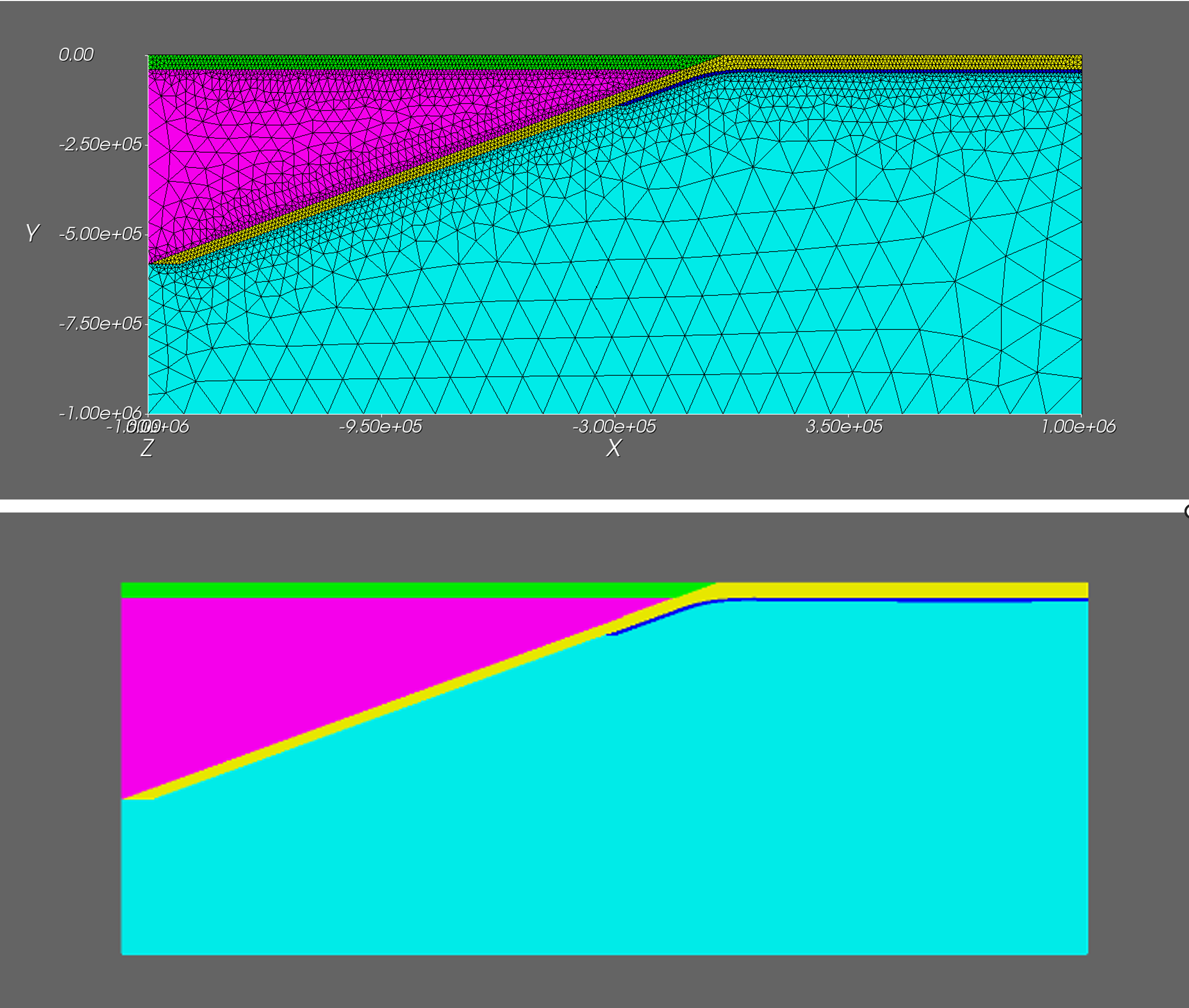
Figure 1. Two‑dimensional subduction‑zone model used for parameter studies. Coreform Cubit scripting enables rapid modification of geometric parameters such as slab dip and layer thickness.
Three‑dimensional modeling for earthquake studies
For earthquake‑rupture and deformation studies in real subduction zones, the team uses Cubit to construct three‑dimensional geological models that incorporate high‑resolution topography, three‑dimensional slab geometry, and major crust–mantle boundaries in a single computational domain. This capability is essential for the group’s study of the Hyuga‑nada region in southwest Japan, where large megathrust earthquakes occurred in 2024 and 2025. The resulting model integrates regional bathymetry and the geometry of the subducting Philippine Sea Plate, providing a realistic basis for characterizing rupture and for conducting elastic and viscoelastic simulations with PyLith.
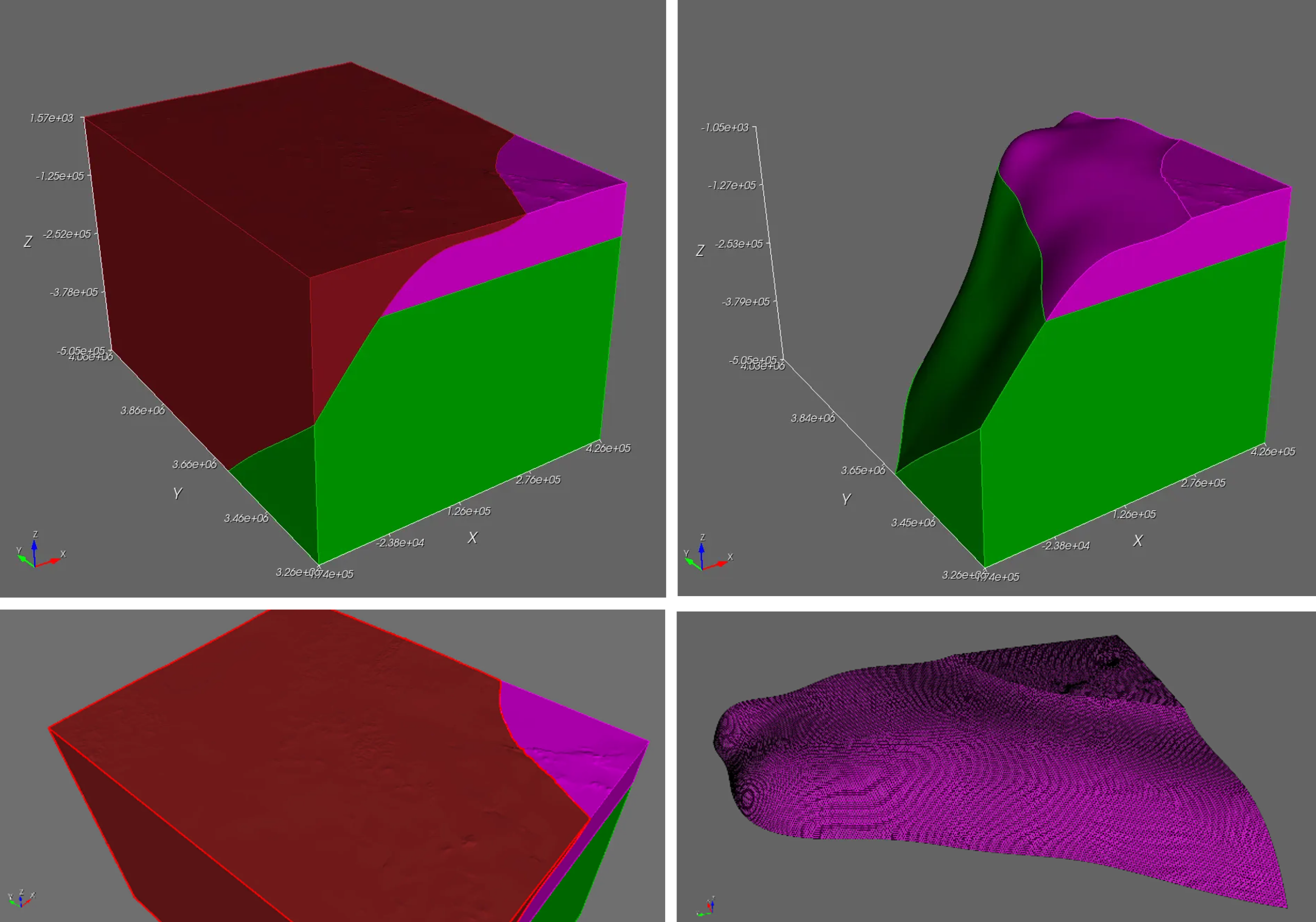
Figure 2. Three‑dimensional finite‑element model of the Hyuga‑nada subduction zone created in Coreform Cubit, showing slab geometry, surface topography, and mesh structure.
Conclusion
Coreform Cubit’s intuitive workflow and scripting tools improve modeling efficiency by enabling rapid adjustment of geometric parameters and automated generation of multiple model configurations. Cubit also supports the construction of realistic geological geometry for earthquake‑deformation studies, making it a reliable platform for both parametric 2D models and detailed 3D tectonic simulations.