
“Coreform Cubit enabled us to create the all-hexahedral boundary layer meshes we needed for our OpenFOAM and FESTIM workflow. Resolving the fluid near the pipe walls was essential to studying tritium permeation, the mechanism our extraction system relies on.”
Kaelyn Dunnell
Master’s student, MIT Plasma Science and Fusion Center
Kaelyn Dunnell | MIT Plasma Science and Fusion Center | August 2026
A master’s student at the Massachusetts Institute of Technology (MIT) used Coreform Cubit to create all-hexahedral boundary layer meshes for OpenFOAM fluid-flow simulations and FESTIM tritium transport modeling. The work supports research into shell and tube tritium extraction systems for fusion fuel cycles.
Background
The MIT Plasma Science and Fusion Center (PSFC) conducts research in plasma physics and fusion science. I work in the Blanket group under Prof. Ethan Peterson, supervised by Dr. Remi Delaporte-Mathurin. Our group studies the production and recycling of tritium fuel for fusion reactors.
My research focuses on simulating proposed tritium systems to inform their design and assess their viability before construction. Tritium is a scarce isotope used as fuel in deuterium–tritium fusion. To achieve tritium self-sufficiency, fusion power plants must produce, extract, and recycle their own tritium through the fusion fuel cycle.
A tritium extraction system (TES) removes tritium from the material in which it is produced, often a liquid metal or molten salt. This project focused on designing and simulating a shell and tube TES to understand tritium transport and extraction efficiency. We also wanted to develop a surrogate model to explore how inlet concentration and inlet velocity affect extraction efficiency.
Problem
We needed a boundary layer mesh for computational fluid dynamics (CFD) simulations in OpenFOAM, followed by tritium transport simulations in FESTIM. In our workflow, FESTIM’s DOLFINx-based finite element solver required a mesh without mixed element topologies. We therefore needed a mesh containing only hexahedral elements, including near the walls.
We evaluated other meshing tools before choosing Coreform Cubit.
Solution
Coreform Cubit enabled us to create the all-hexahedral boundary layer mesh we needed. Its sweep meshing capabilities and availability on macOS were important factors in our choice, since I was working on a MacBook.
Near-wall resolution matters in this application because fluid transport at the boundaries affects tritium permeation through the pipe walls and, consequently, extraction efficiency. The boundary layer mesh provided resolution in this region for our flow and transport simulations.
Workflow
We created the geometry in CADQuery, meshed it in Coreform Cubit, ran CFD simulations in OpenFOAM, and modeled tritium transport in FESTIM. We then used AutoEmulate to build a surrogate model from the multiphysics simulation results.
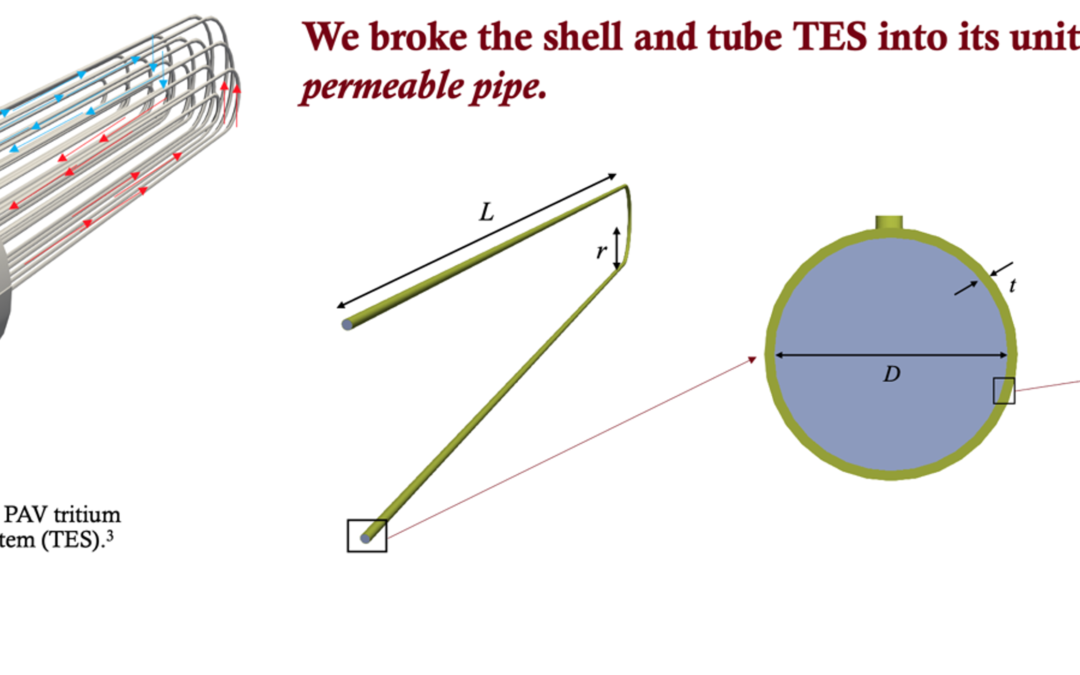
We initially attempted to generate a boundary layer mesh for the complete shell and tube TES. We were unable to produce the desired mesh for the full geometry, with its many holes and curves, so we divided the system into individual permeable pipes and applied the workflow to those components.
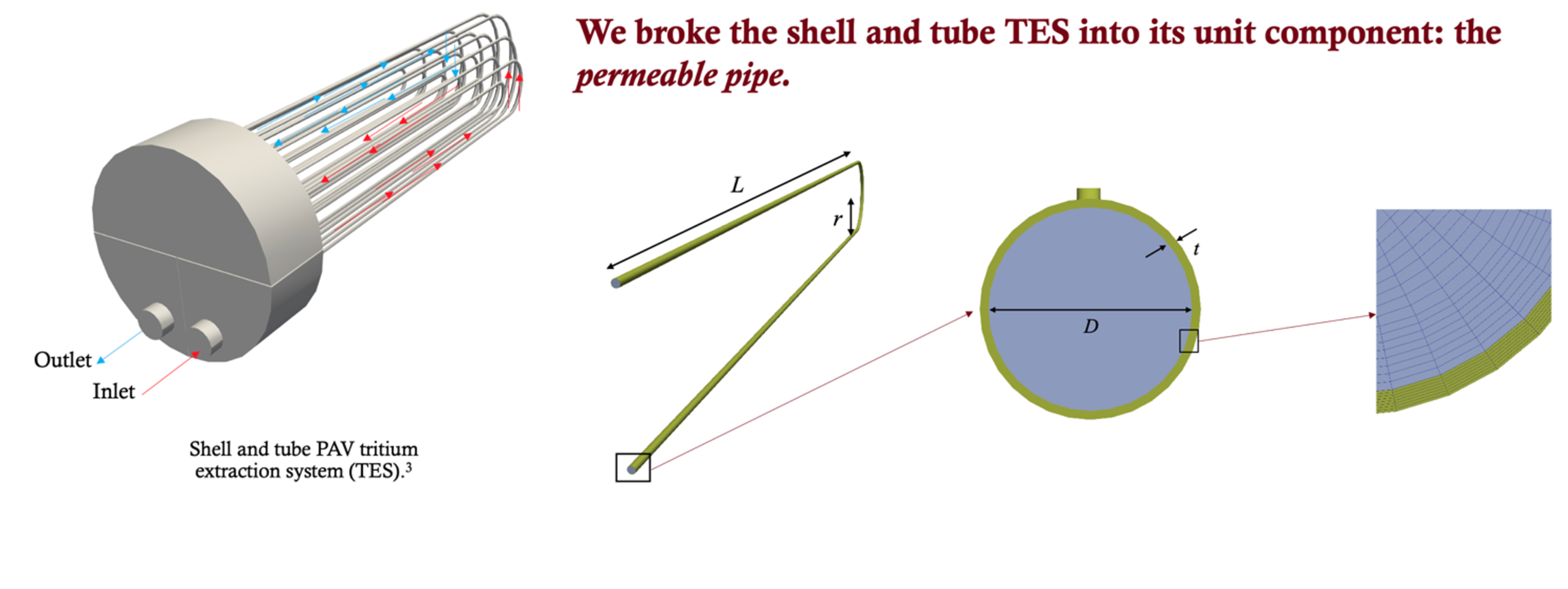
Figure 1. The shell and tube tritium extraction system (left) was divided into individual permeable pipes for simulation. The pipe geometry, cross-section, and mesh detail (center and right) show the boundary layer mesh created with Coreform Cubit near the wall, where fluid transport affects tritium permeation. System illustration source: Bonifetto et al., Fusion Engineering and Design 167 (2021), 112363.
Results
Issues with the FESTIM tritium transport code remain unresolved, so extraction-efficiency estimates are omitted here. The transport simulations and surrogate predictions remain preliminary.
The simulations indicated that turbulence increased mixing and helped homogenize tritium within the fluid. Tritium transport was strongly dependent on mass transfer through the fluid, making boundary layer physics important for understanding permeation through the pipe walls. In this application, that permeation is the desired extraction mechanism.
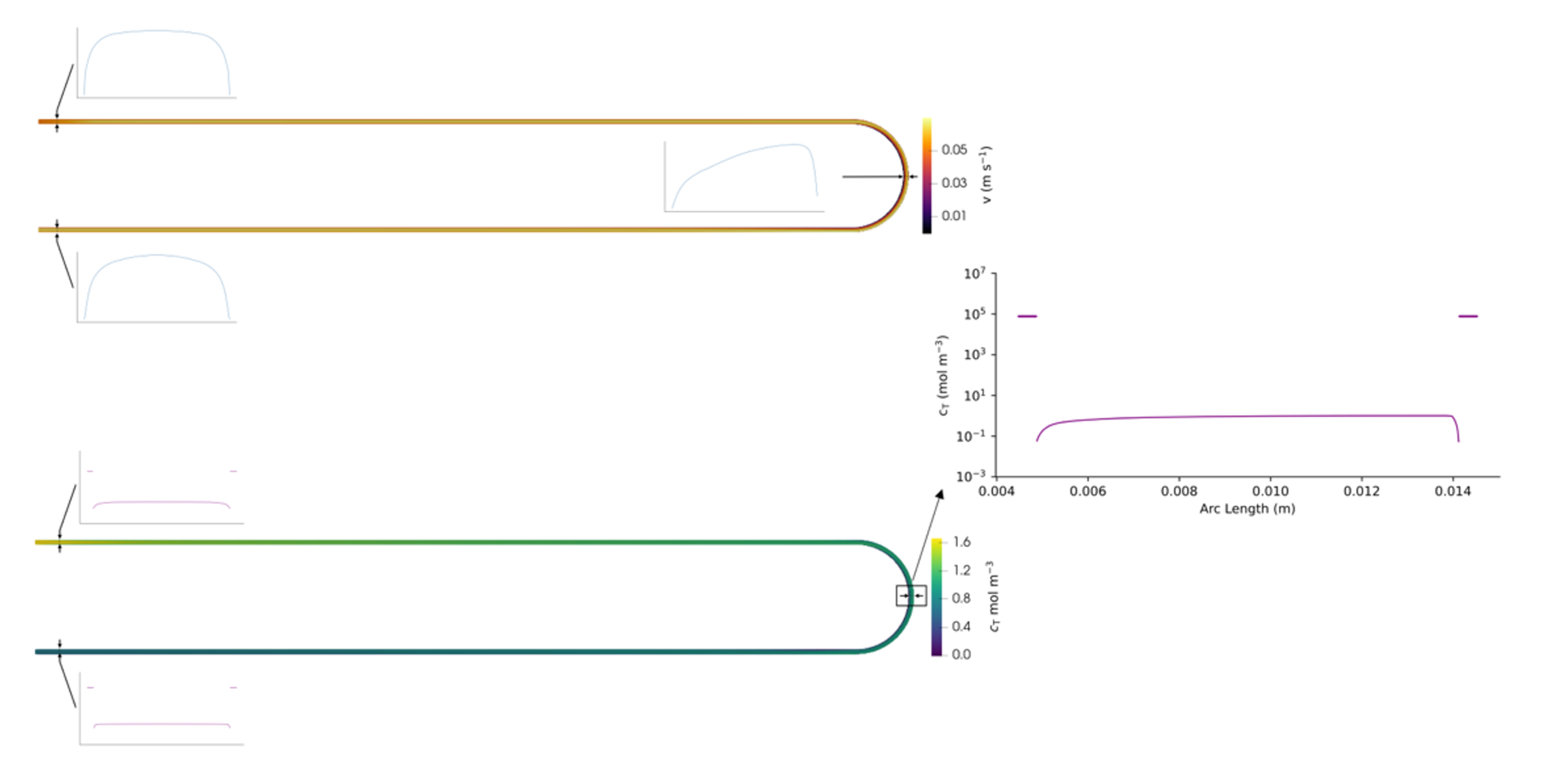
Figure 2. Simulated fluid velocity (upper left) and tritium concentration (lower left) in a permeable pipe, with profiles at selected locations. The plot on the right shows tritium concentration versus arc length across a section at the pipe bend. These transport results remain preliminary pending resolution of the FESTIM issues described above.
Surrogate model
We also built a surrogate model from the multiphysics simulation results to support rapid exploration of inlet concentration and inlet velocity. The surrogate’s predictions inherit the limitations of the underlying transport simulations.
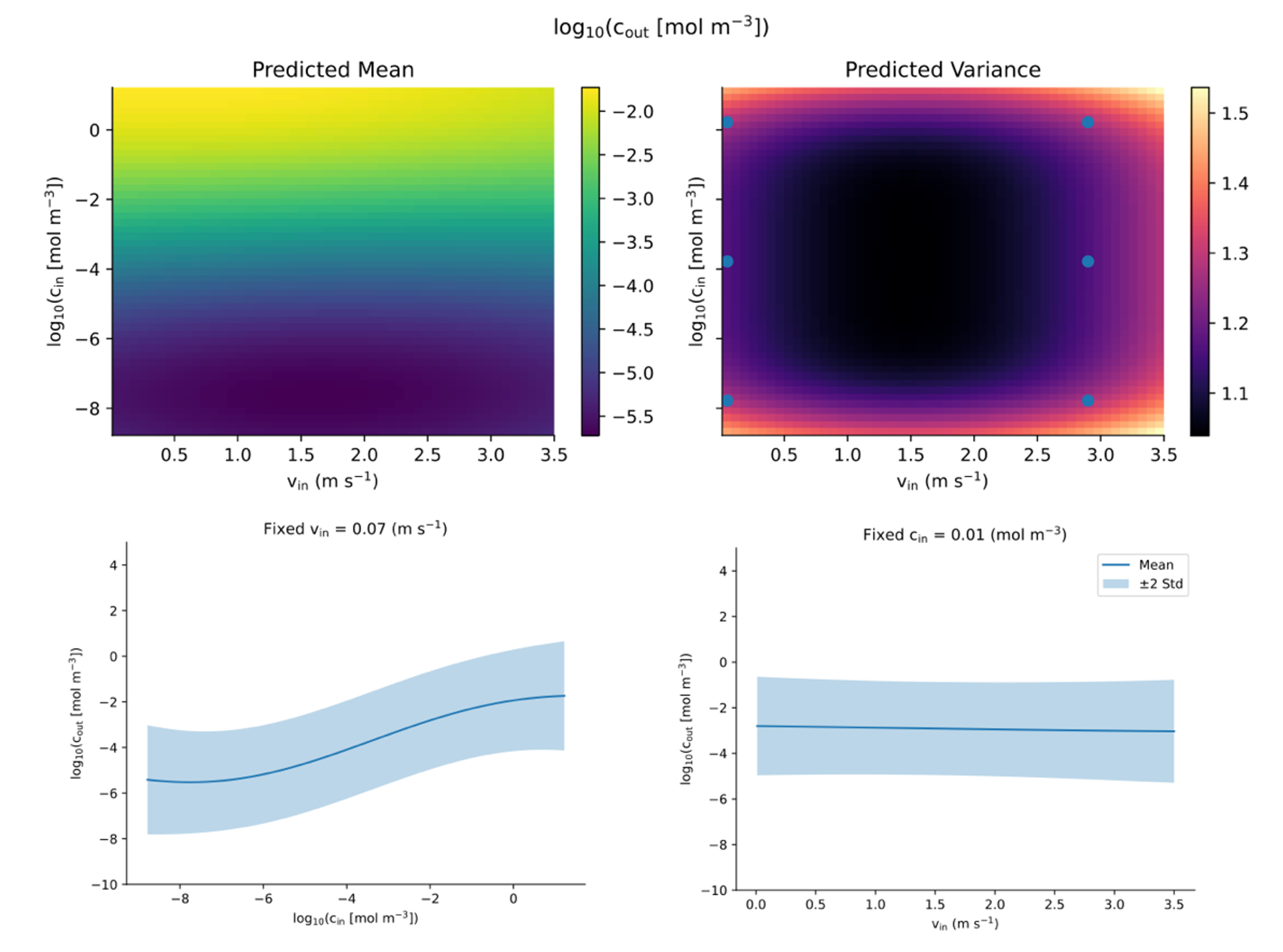
Figure 3. The surrogate model predicts permeable-pipe outlet concentration from inlet velocity and inlet concentration. The upper panels show the predicted mean and variance of log10 outlet concentration. The lower panels show dependence on inlet concentration (left) and inlet velocity (right), with bands of ±2 standard deviations. In this study, extraction efficiency is calculated by subtracting the ratio of outlet to inlet concentration from 1. Predictions remain preliminary.
Conclusion
Coreform Cubit supplied the all-hexahedral boundary layer meshes needed for our OpenFOAM and FESTIM workflow. This helped us investigate near-wall fluid transport and tritium permeation in a proposed fusion fuel extraction system. The workflow also supported development of a surrogate model for future design exploration, while the transport results still require validation.
Learn more about the MIT Plasma Science and Fusion Center and the project’s modeling workflow.