

“Coreform Cubit was selected because it provides flexible geometry operations, controlled meshing, repeatable scripting, and compatibility with the SPECFEM3D workflow. Automation substantially reduced repeated model-preparation work and improved consistency across the simulation dataset.”
Central Michigan University research team
Nondestructive evaluation research
Background
The research group led by Dr. Chanseok Jeong at Central Michigan University develops nondestructive evaluation methods that combine ultrasonic measurements, high-fidelity simulations, and artificial intelligence.
The current project focuses on detecting and localizing internal defects in steel pipelines. Creating a large experimental dataset covering many defect sizes, shapes, and locations would be costly and time-consuming. The team therefore uses Coreform Cubit to prepare and mesh pipeline models, SPECFEM3D to simulate elastic wave propagation, and the resulting sensor data to train a convolutional neural network.
Problem
The project required thousands of thin-walled steel pipeline models containing internal defects with different sizes, shapes, and locations. Each model needed a sufficiently fine and consistent hexahedral mesh for ultrasonic wave propagation, along with correctly defined material regions and boundaries for SPECFEM3D.
Creating the geometry, partitioning and meshing each model, assigning boundaries, and exporting every case manually would have been slow and could have introduced inconsistencies across the simulation dataset. The researchers needed a repeatable workflow that could generate many comparable models while varying only the intended defect parameters.
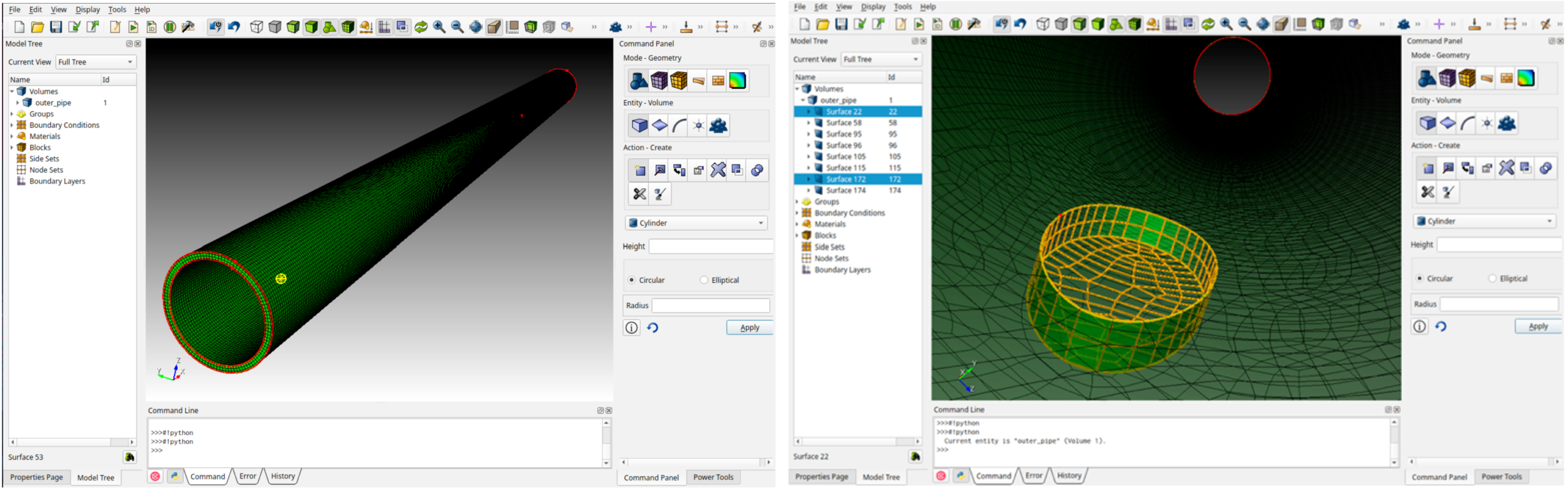
Figure 1. A hollow steel pipeline model in Coreform Cubit, including a close-up of an internal wall defect and the surrounding hexahedral mesh.
Solution
Coreform Cubit was used to create the hollow pipe through Boolean subtraction, introduce internal defects, partition the geometry with webcuts, generate the hexahedral mesh, and define material blocks and boundary sidesets. Its scripting capability allowed the same modeling procedure to be reused for different defect configurations.
Coreform Cubit was selected for its flexible geometry operations, controlled meshing, repeatable scripting, and compatibility with SPECFEM3D. Technical webinars and guidance from Coreform also helped the research team establish the workflow.
The automated process defines the pipe and defect parameters, creates and meshes the model in Coreform Cubit, exports the mesh to SPECFEM3D, simulates ultrasonic wave propagation, records sensor displacement signals, and uses those signals to train an AI model to predict defect locations.
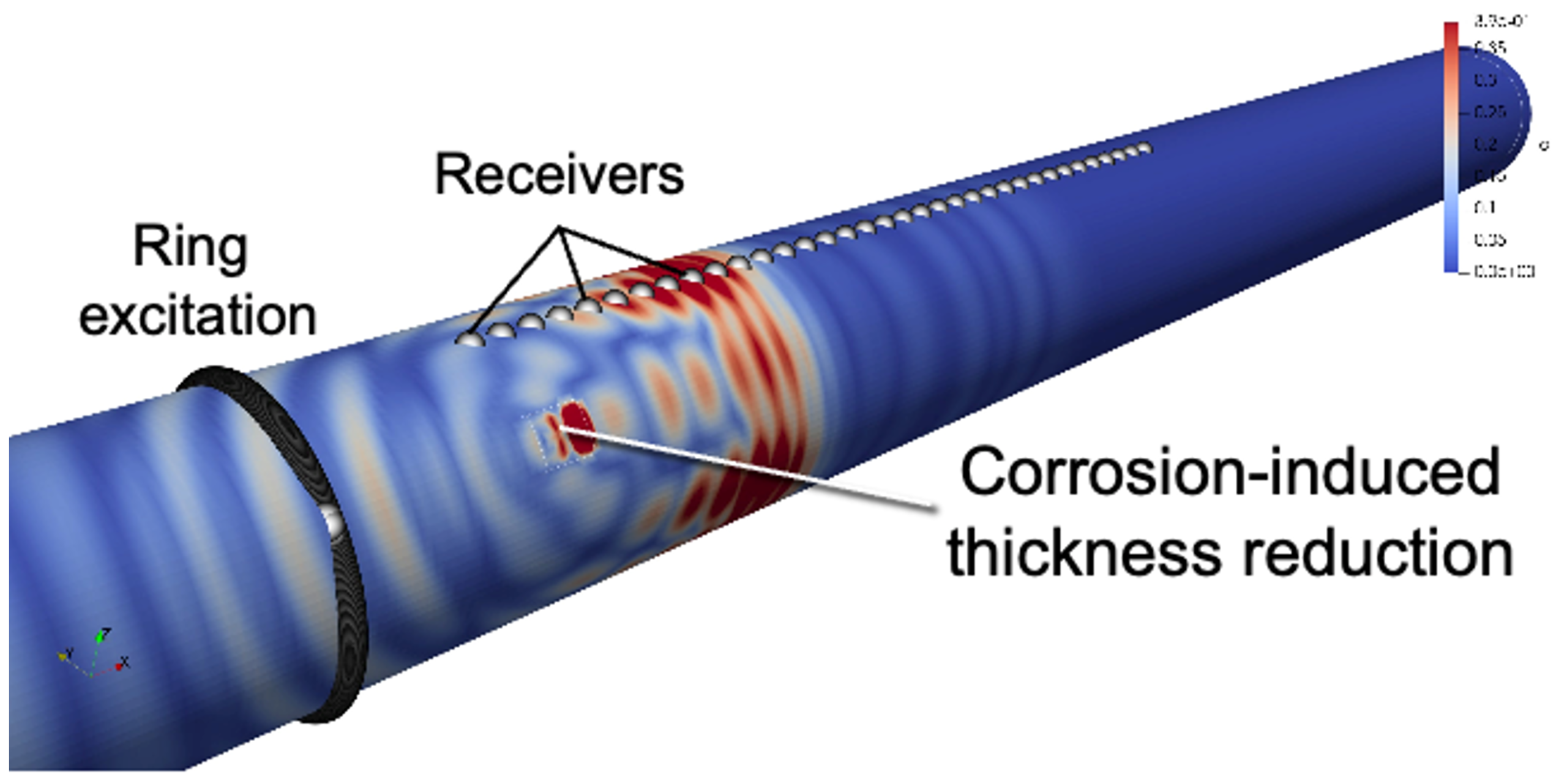
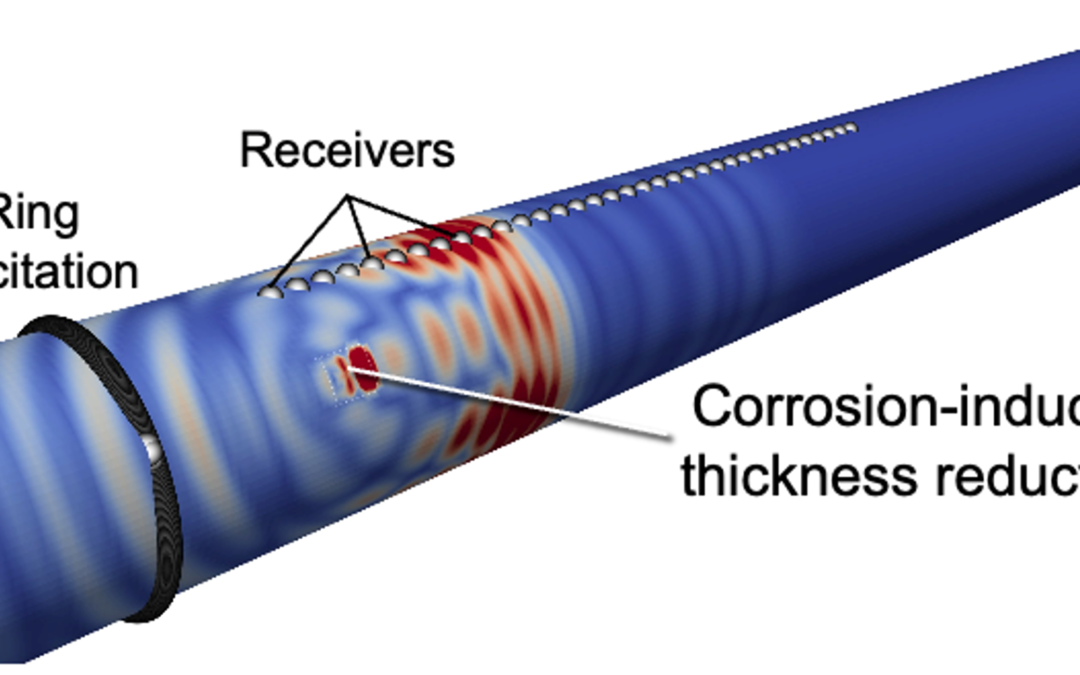
Figure 2. SPECFEM3D simulation configuration showing the ultrasonic ring excitation, receiver array, and corrosion-induced wall-thickness reduction.
Results
In the study, the team created and simulated more than 17,000 defect configurations with the automated Coreform Cubit-to-SPECFEM3D workflow. The simulations produced wave signals containing defect-related scattering and reflections, and the convolutional neural network used those signals to reconstruct internal defect locations on a defect map.
For one representative pipeline mesh containing 194,213 HEX8 elements, SPECFEM3D's xcheck_mesh_quality utility found no negative Jacobians. The maximum equiangle skewness was 0.674, while the maximum edge and diagonal aspect ratios were 3.97 and 2.04, respectively. Cubit reported Jacobian values ranging from 3.64 × 10⁻⁸ to 2.44 × 10⁻⁷.
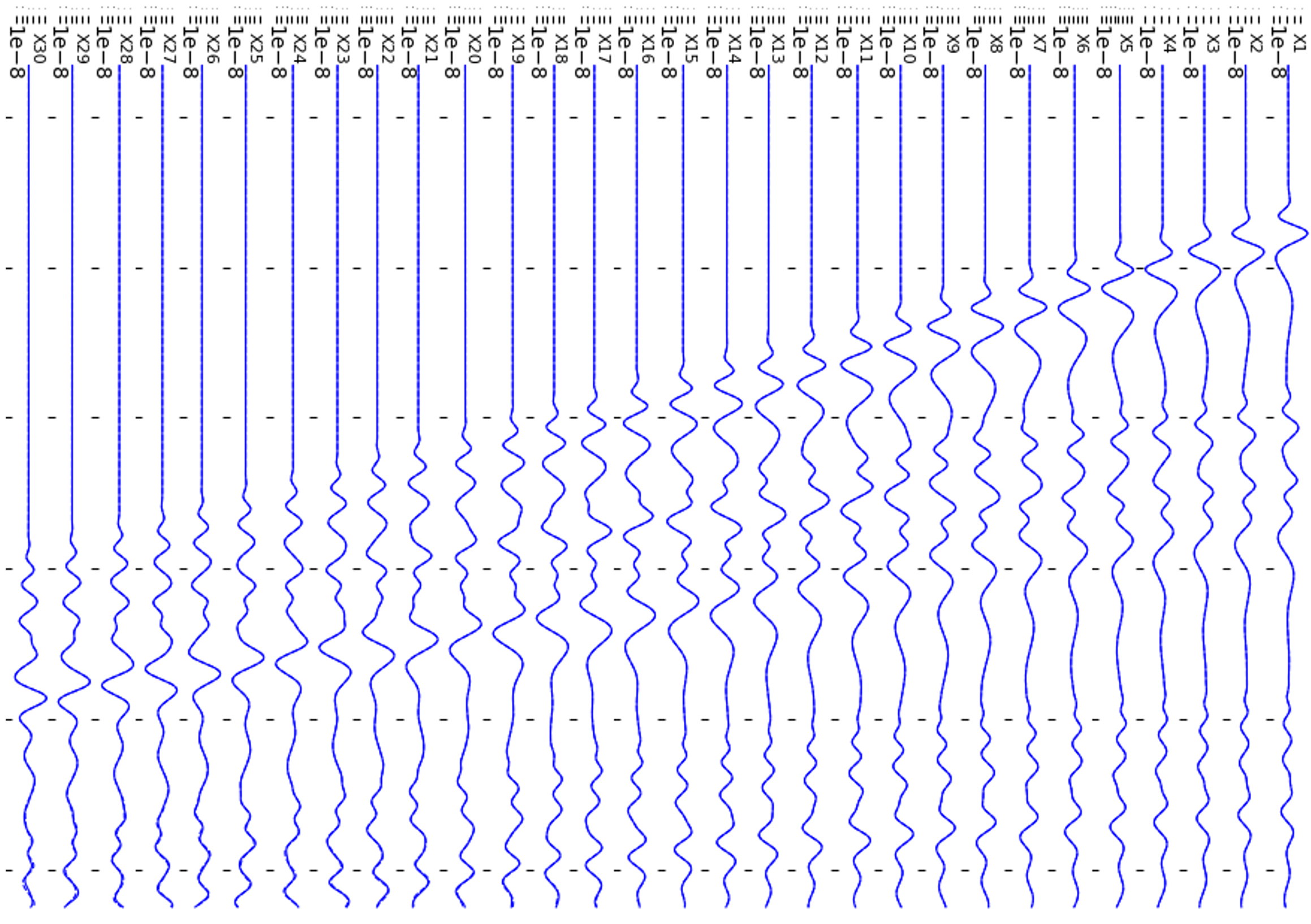
Figure 3. Simulated displacement signals recorded by the receiver array. The signals contain scattering and reflections caused by the internal pipeline defect.
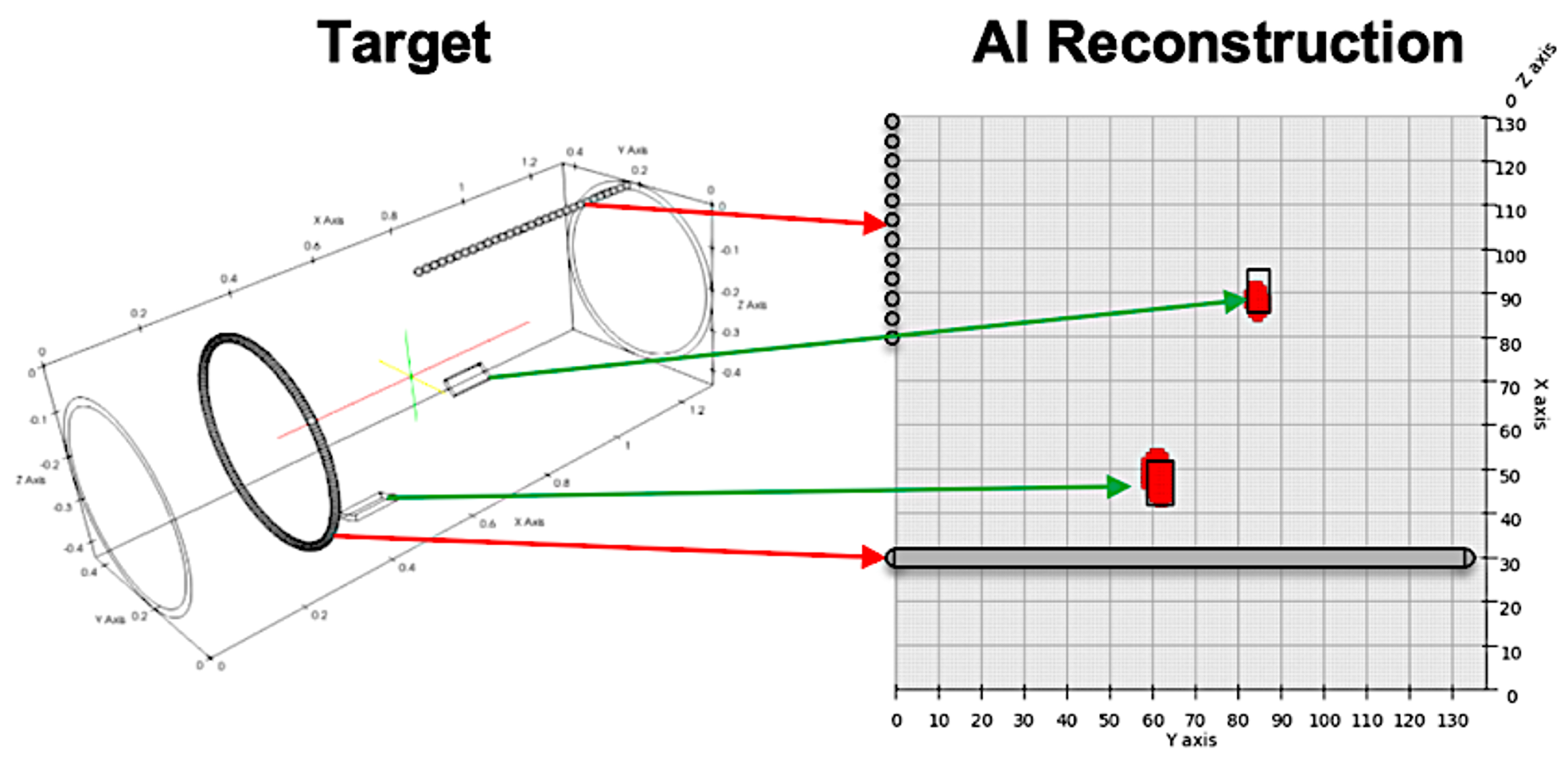
Figure 4. Comparison of the target defect locations with the convolutional neural network's AI reconstruction from simulated ultrasonic measurements.
Conclusion
Coreform Cubit provides the model-preparation foundation for Central Michigan University's AI-enabled pipeline inspection research. Its Boolean geometry tools, webcut capabilities, mesh controls, boundary definitions, and scripting workflow support consistent pipeline models across a wide range of internal defect configurations.
By reducing repeated manual work and improving reproducibility, the workflow helps the team generate reliable ultrasonic simulation data at the scale needed to train an AI model for internal defect detection and localization.