

For years, Cubit has been my core meshing tool in exploring earthquake phenomena, enabling me to express my scientific vision through advanced numerical models.
Dr. Christodoulos Kyriakopoulos
Assistant Professor, Center for Earthquake Research and Information, The University of Memphis
Background - Lab mission
The Earthquake Modeling and Visualization Lab at the University of Memphis aims to advance earthquake science by using physics-based numerical simulations to study earthquake rupture processes. The lab provides a framework for testing hypotheses about past and future major earthquakes, producing results that are both scientifically rigorous and practically relevant for evaluating the main mechanism behind earthquake rupture. Earthquakes are complex phenomena, controlled by factors like variable fault geometry, initial stress conditions, material rheological properties, and topography. Coreform Cubit is a key tool for bringing these elements together in comprehensive finite element models. Dr. Christodoulos Kyriakopoulos has more than 15 years of experience with Coreform Cubit (formerly Trelis). We use “Cubit” as a unified term for the software throughout.
Over the past decade, Dr. Kyriakopoulos used Coreform Cubit to tackle a variety of earthquake-related problems across different tectonic settings, from the strike-slip San Andreas fault boundary system to subduction megathrust earthquakes off the coasts of Japan and Costa Rica. His lab specializes in building realistic finite element models of the Earth system, which, however, incorporate modular architecture, enabling the systematic breakdown and analysis of complex earthquake processes. This approach helps his team identify and rank the dominant factors that control rupture behavior. By isolating and testing these factors, the lab gains a better understanding of how ruptures start and propagate across faults, how and when fault geometry and topography generate first-order stress perturbations, and when earthquakes cascade into multi-fault ruptures. Examples of the lab’s latest work are presented below.
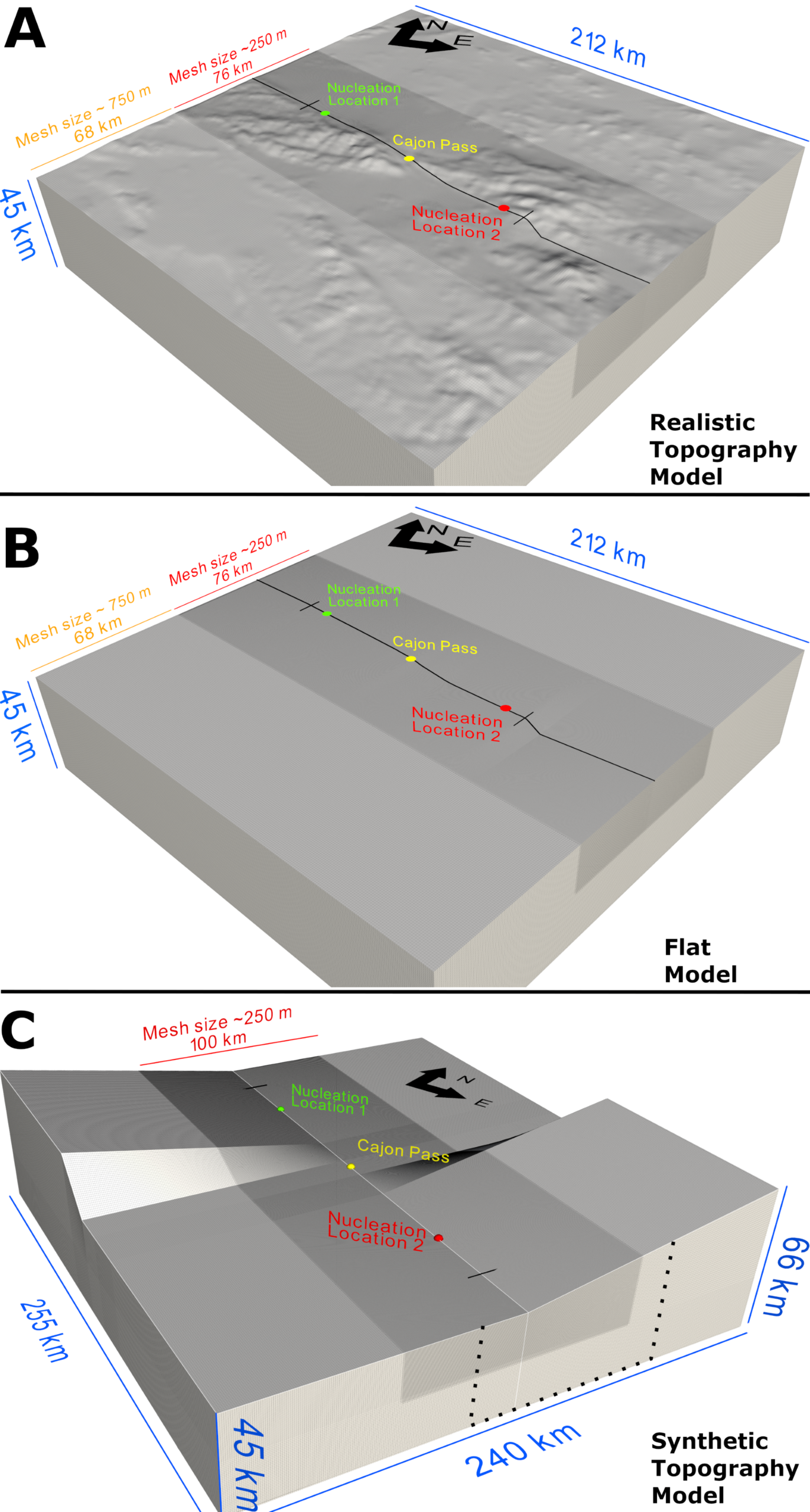
Figure 1. Collection of FEM models used in a study of the Cajon Pass. (A) Realistic topographic model capturing first-order features of the asymmetric topographic transition (San Bernardino and San Gabriel mountains) across the Cajon Pass, CA. The San Andreas fault is implemented in the middle of the domain dividing the model in two parts. (B) Flat "topography" model incorporating the same fault geometry as the model in panel (A), but with a flat top surface. (C) A synthetic topographic model was developed to isolate the pure dynamic asymmetric topographic effect. All cases implement hexahedral meshing with refinement surrounding the San Andreas fault.
.
Problem 1
Kyriakopoulos and his team focused on modeling ruptures along the San Andreas Fault (SAF) as it crosses the Cajon Pass, between the San Bernardino and San Gabriel mountains. A key challenge was the implementation of the uneven (asymmetric) topography, which shifts from one side of the fault to the other after crossing the pass. Accurately including the irregular topographic surface within a model that also includes the fault interface of the SAF was crucial for understanding how the shape of the earth’s surface affects rupture dynamics.
Solution 1
Coreform Cubit played a central role in building a family of 3D model domains, ranging from realistic DEM-derived topography to synthetic and flat free-surface variants. Using Cubit’s ACIS-based geometry tools, the team constructed a closed, simulation-ready volume from a topographic surface, lateral boundaries, and a basal surface, then incorporated the San Andreas fault as an internal feature to partition the domain for targeted analysis. With the geometry established, they generated a structured hexahedral mesh and applied focused local refinement around the fault to better resolve stress gradients. These meshes enabled the authors to separate stress changes driven by variations in fault geometry (such as fault strike changes) from those associated with asymmetric topography along the fault.
Dynamic rupture simulations were performed using the FEM code FaultMod. Comparing dynamic simulations with and without topography showed that uneven topography can cause normal stress changes both ahead of and behind the rupture front, revealing a new mechanism not previously reported in peer-reviewed literature.
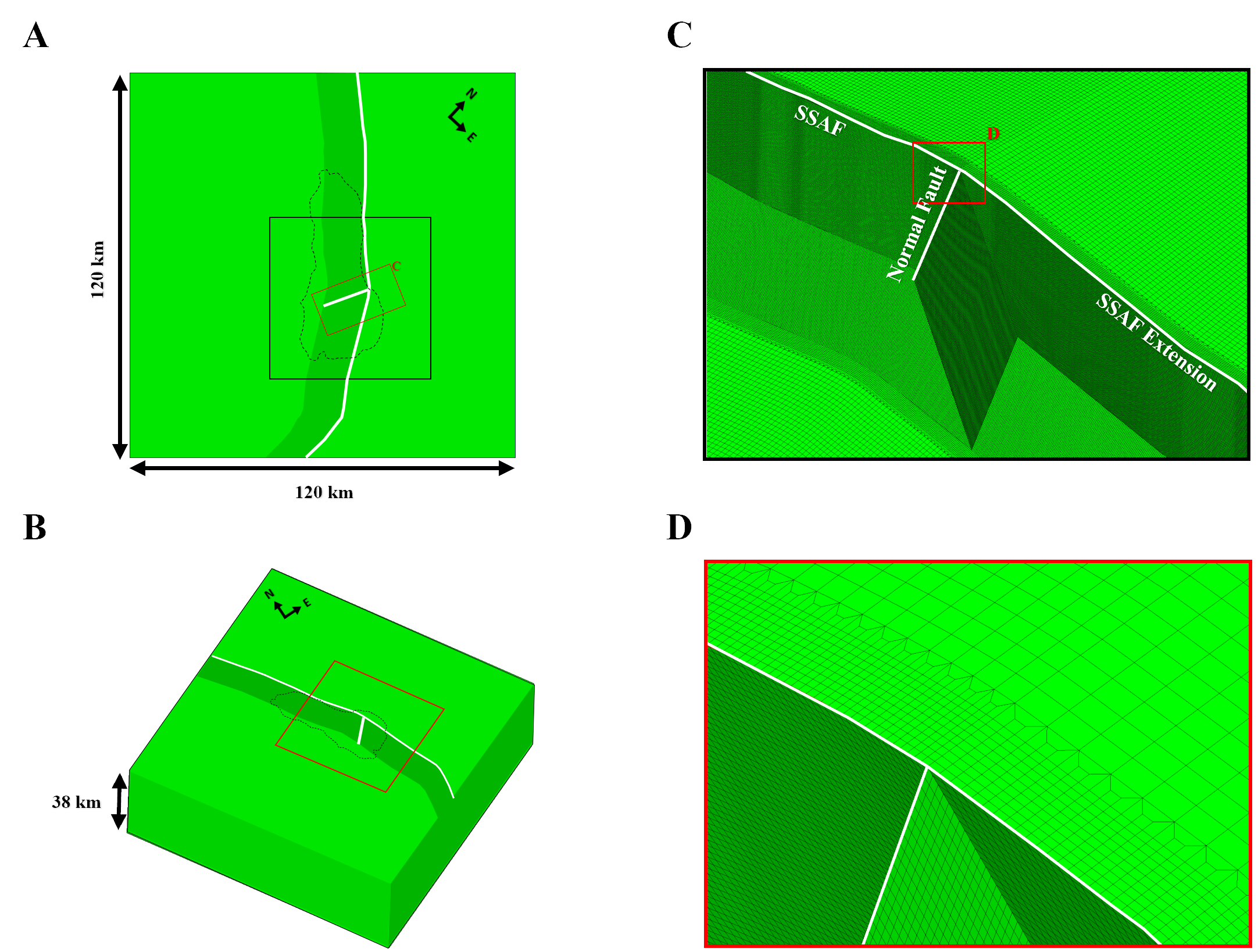
Figure 2. Details of the hexahedral mesh developed to study the dynamic interactions between the San Andreas fault and an adjacent smaller normal fault under the Salton Sea, CA. Panels (A) and (B) show a map and a rotated 3D view of the total model domain. Panels (C) and (D) show details of the mesh near the San Andreas-normal fault intersection. Mesh refinement is implemented within the volumes that contain the faults and their intersections. The black dashed line in panel (A) indicates the Salton Sea shoreline.
Problem 2
More recently, the team expanded the scope of dynamic rupture modeling to cases with multi-fault systems. They specifically explored the dynamic interactions between the Southern San Andreas Fault (SSAF) and adjacent smaller fault structures in the Brawley Seismic Zone (BSZ) in California. The BSZ is characterized by intense microseismicity and seismic swarms that often occur along small left-lateral strike-slip faults and, in certain instances, normal faults. Occasionally, seismic swarms include moderate-size events (M5-M6), which, due to the adjacency with the SSAF, raises the question of whether one of these smaller events could trigger a major earthquake on the SSAF. The challenge for both investigations is to generate finite element meshes that accurately represent adjacent or intersecting faults. Capturing the intersection of faults with different orientations and dip angles requires precise meshing to avoid numerical artifacts.
Solution 2
Coreform Cubit made a fundamental contribution by enabling a conforming, high-quality hexahedral mesh across the San Andreas fault system, including the intersection with adjacent structures. The team used Cubit to build the fault surfaces and partition the surrounding domain so that both faults and their intersection could be meshed with a consistent element size, then applied targeted local refinement in the fault zone while keeping a coarser mesh elsewhere. This combination — well-shaped hex elements, controlled element sizing across interfaces, and localized refinement where physics demands it — improved numerical stability in dynamic rupture simulations and helped the model accurately capture complex fault interactions (such as rupture jumps or early termination of rupture) without unnecessary computational cost.
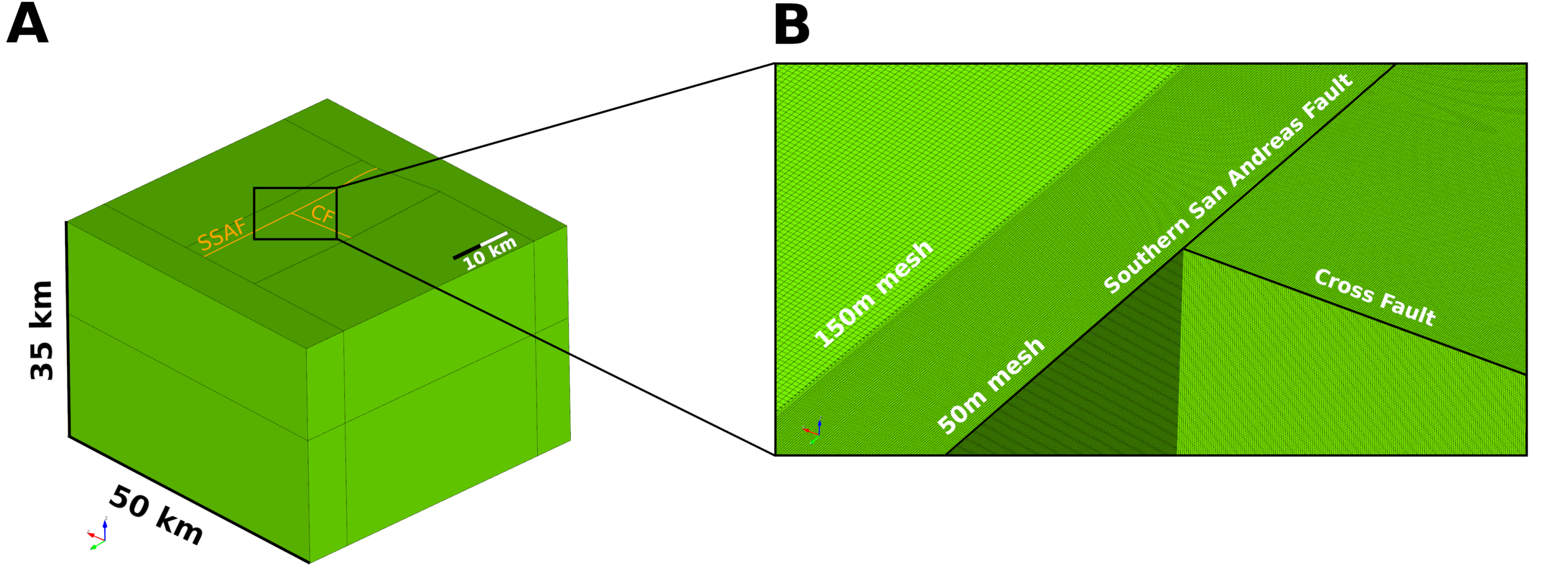
Figure 3. Mesh details of the intersection between the San Andreas and a left-lateral cross fault south of Bombay Beach, CA, in the Brawley Seismic Zone. (A) Full 3D view of the model domain. (B) Hexahedral mesh details with refinement within the volumes surrounding the faults.
Conclusion
Through dynamic rupture simulations, the Problem 1 project shows that stress transfer from the Southern San Andreas Fault (SSAF) can trigger slip on the nearby normal fault (NF), and that the direction of rupture propagation on the San Andreas (North-to-South vs South-to-North) might determine the nature of such interaction and eventually the amount of NF slip. Their modeling results emphasize that the interpretation of paleoseismic events must consider both the SSAF and the surrounding secondary faults, providing a guide for future investigations.
The Problem 2 studies examined whether cross-fault moderate-magnitude earthquakes in the Brawley Seismic Zone (BSZ) could dynamically trigger a major rupture on the SSAF (e.g., “the big one”). Through simulations, the authors found that moderate cross-fault events can indeed initiate slip on the SSAF, and laid out the roadmap of a series of possible scenarios. This finding is significant because it suggests that even relatively small cross-fault earthquakes could play a role in initiating large San Andreas events raising questions about the potential for cascading seismic activity.