

“Coreform Cubit handles geometries we simply couldn't mesh before. For our plasma simulations in PICLas, getting from complex customer CAD to a clean hexahedral mesh used to be the bottleneck, and now it isn't.”
Paul Nizenkov
boltzplatz
Engineering service provider and PICLas simulation specialist
Background
boltzplatz is an engineering service provider and a spin-off from the University of Stuttgart, Germany. At the heart of the company lies the open-source software PICLas, which was originally developed to simulate space systems, including atmospheric entry and in-space propulsion. PICLas allows the prediction of rarefied gas and plasma dynamics under the influence of electromagnetic forces. Thanks to a successful technology transfer, companies in the semiconductor manufacturing and vacuum coating industries developing vacuum and plasma technologies can leverage these numerical simulations. This approach reduces the need for costly prototypes and extensive testing, saving both time and expenses. Beyond complete simulation projects, boltzplatz offers technical support and software development for PICLas. For more information on the simulation software and potential applications, please visit the website: https://boltzplatz.eu/.
Problem
The employed methods in PICLas require high-quality hexahedral meshes for improved accuracy and to accelerate convergence. The application in this case study is a reactive magnetron sputtering process within a physical vapor deposition (PVD) coating chamber, where particles get reactively sputtered from a target and are deposited on a substrate. Such plasma-based coating processes are widely used in thin film production, advanced surface coatings, and semiconductor manufacturing. To better understand and optimize the underlying physical processes, simulations provide an efficient and accessible way of gaining detailed insight into particle transport and deposition behavior within the chamber.
However, due to the geometric complexity of the full chamber, simulating the entire domain would result in excessive computational cost and meshing effort. Therefore, the simulation is restricted to the physically relevant region of the chamber. This reduction significantly simplifies the geometry while still capturing the essential physics of the coating process. In addition, only a specific region of the target actively contributes to the sputtering process. To accurately represent this behavior in the simulation, the corresponding boundary must be subdivided into two parts (see Figure 1).
To generate a high-quality hexahedral mesh for this reduced simulation domain, Coreform Cubit has been utilized. Several commercial mesh generators have been considered in the past to create fully hexahedral meshes. While the multi-block approach provided the required mesh quality and allowed precise control over the number of cells, its application was cumbersome and did not permit flexible CAD geometry modifications.
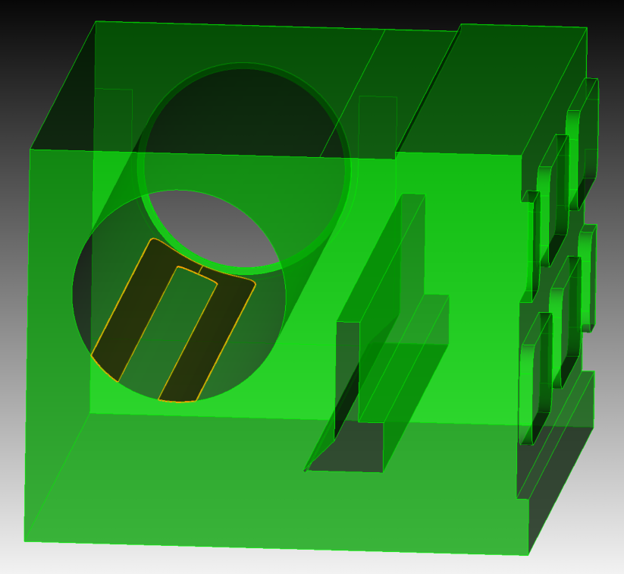
Figure 1. The complete simulation domain and its separated boundaries, with the emission zone highlighted on the cylindrical target, in Coreform Cubit.
Solution
With Coreform Cubit, a compromise between mesh quality, control, and ease of use has been found. The mesh generation process starts with the CAD file provided by the customer. These files are usually not suitable for simulation and meshing without additional preparation. The CAD manipulation options enable boltzplatz to perform geometry simplifications, domain reduction, boundary partitioning, and geometry corrections directly in Coreform Cubit. This avoids the cost of expensive CAD software and streamlines the preparation of simulation-ready models.
During the meshing process, the complex, winding geometry was meshed using tetrahedrons, which were then fully split into hexahedrons. After mesh generation, the quality of the mesh was verified in Coreform Cubit using the scaled Jacobian metric, which allowed problematic elements to be located and corrected. The resulting mesh for the coating chamber comprised roughly 73,000 cells (see Figure 2). A central goal for boltzplatz is to reach a valid mesh with as few cells as possible, which keeps simulation cost low, and Coreform Cubit is well suited to this. Finally, the mesh is converted by the boltzplatz preprocessor for use within the PICLas simulation software.
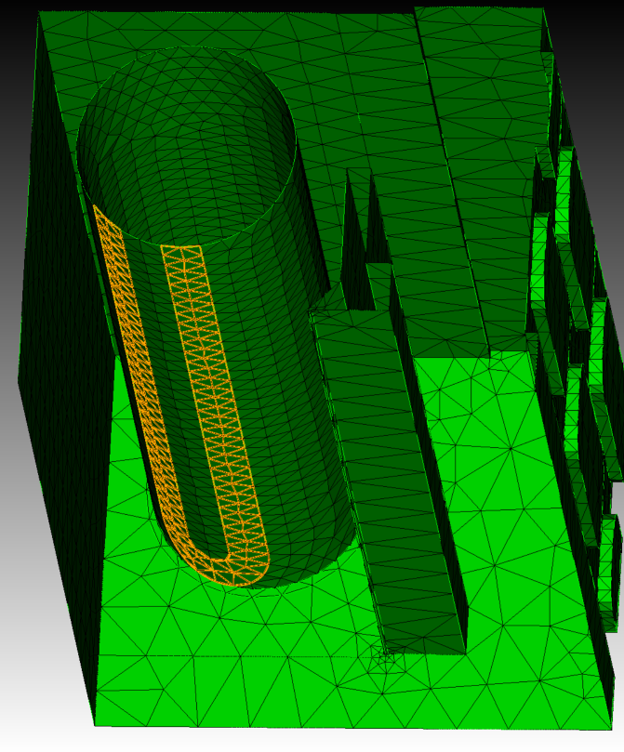
Figure 2. The surface mesh and the separated emission zone in Coreform Cubit.
Conclusion
Plasma-based processes play a crucial role in technologies such as vacuum surface coating and semiconductor manufacturing. In this case study, a magnetron sputtering coating chamber has been successfully simulated by boltzplatz and the results provide detailed insights into particle transport and deposition within the process chamber (see Figure 3). For this model, geometry preparation and mesh generation took under an hour in Coreform Cubit, where most of that time was spent on CAD cleanup and setting boundary conditions. The same work typically takes three to five hours with other mesh generators. In several cases that cannot be shown here for reasons of confidentiality, geometries that could not be meshed with other tools were meshed successfully in Coreform Cubit. Future simulations with the high-quality meshes generated by Coreform Cubit, combined with short turnaround times for geometry preparation and mesh generation, can help accelerate process development cycles and reduce the need for extensive physical testing.
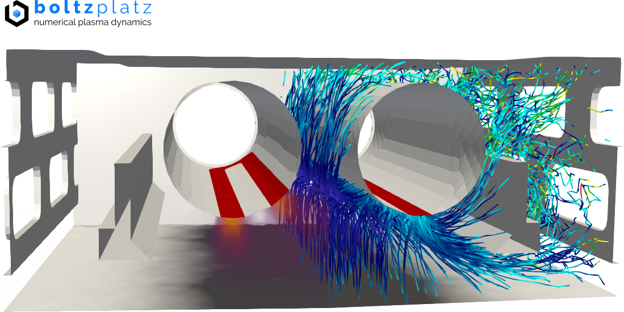
Figure 3. A simulation result showing the sputtered material, its streamlines, and the deposition on the substrate at the bottom of the chamber. The emission zone is colored red for orientation.