
Resources / Case Studies /
IGME-CSIC uses Coreform Cubit to build complex 3D fault geometries for earthquake simulations
Paula Herrero-Barbero and the GEOSMART research group at IGME-CSIC use Coreform Cubit to construct realistic 3D fault surfaces, generate high-quality triangulated meshes, and export simulation-ready STL files for physics-based earthquake modeling.
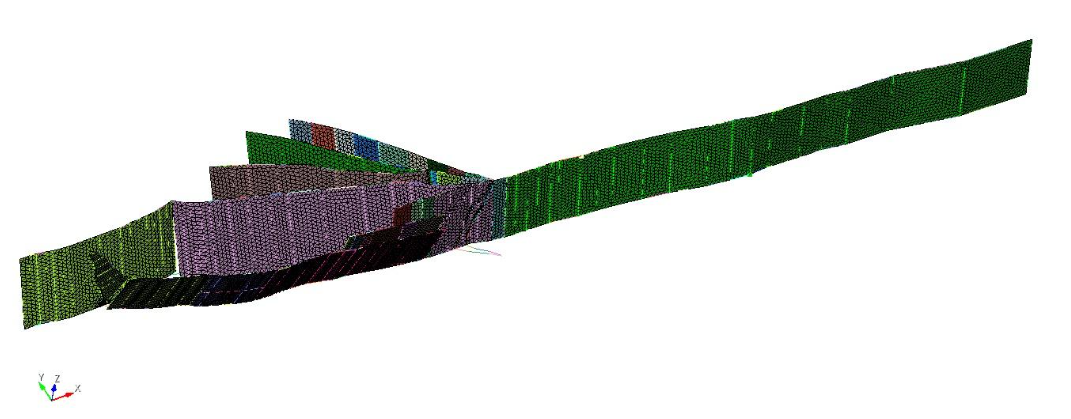
Cubit allows us to construct consistent 3D fault surfaces, create high-quality triangulated meshes that preserve the structural complexity of the fault system, and export them in formats fully compatible with our simulation workflow.
Paula Herrero-Barbero
Geoscience researcher, GEOSMART, IGME-CSIC
Background
The GEOSMART research group at the Geological and Mining Institute of Spain (IGME-CSIC) studies active geological processes using modeling, artificial intelligence, and remote sensing. One of the group’s research areas focuses on earthquake physics and seismic hazard in active fault systems, with the goal of understanding how fault geometry and structural complexity influence earthquake nucleation, rupture propagation, and long-term seismic behavior.
Because earthquakes unfold over long time scales and at depths that cannot be directly observed, numerical simulation is essential. Physics-based seismic cycle simulations help researchers study how stress accumulates on faults and how rupture propagates during earthquakes. These simulations depend on realistic three-dimensional fault geometries that capture the complexity seen in nature.
Problem
Physics-based earthquake simulations require realistic 3D representations of fault surfaces together with computational meshes that can be used directly by numerical solvers. Building those geometries is difficult because natural fault systems are structurally complex, often containing multiple interacting fault segments with irregular shapes and changing orientations.
In this workflow, the team needed a specific type of triangulation that other modeling tools, including MOVE, could not provide. Their simulation code also requires mesh export in STL format. Before adopting Coreform Cubit, the process relied on MOVE, but surface construction and meshing were more time-consuming and less flexible.
Solution
Coreform Cubit gave the team an efficient environment for constructing complex 3D fault geometries and generating the triangulated meshes required for earthquake simulations. A key advantage was Cubit’s ability to export meshes directly in STL format, which fits cleanly into the team’s simulation workflow.
The workflow begins with mapped fault traces at the surface, imported into Coreform Cubit as lines with geographic coordinates. From those traces, Cubit is used to build the three-dimensional fault surfaces and generate triangulated meshes representing the fault system at different mesh resolutions. The mesh is then exported in STL format and used as input for physics-based earthquake simulation codes.
Compared with other structural geology tools, Coreform Cubit provided the right combination of geometric flexibility, reliable mesh generation, and straightforward export to the formats required by the project. The team also found Coreform’s online forum and webinars useful for learning and refining the workflow.
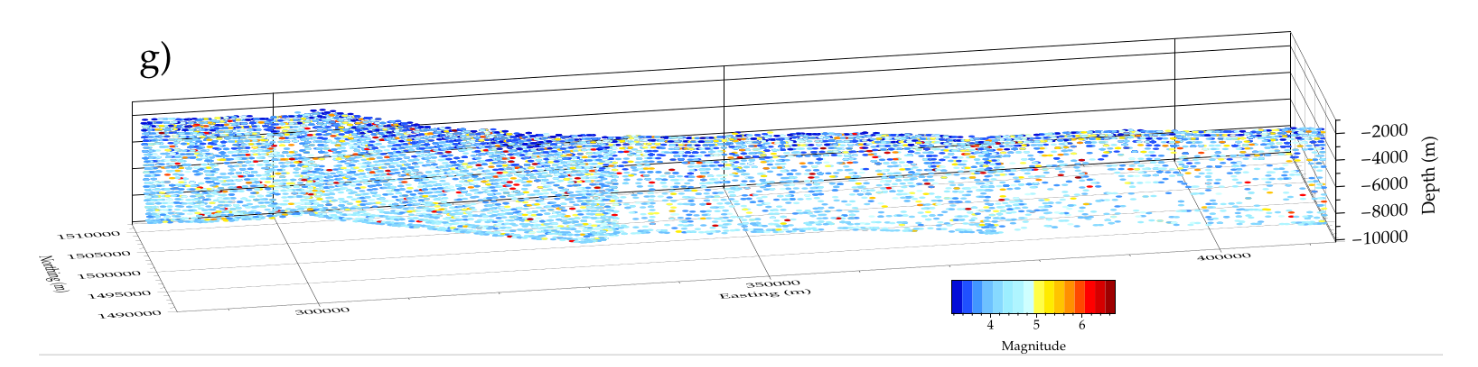
Synthetic seismicity distribution from seismic cycle simulations using the simpler fault-system model.
Results
Using Coreform Cubit improves the efficiency and reliability of model preparation for the team’s seismic simulation workflow. The geometries and meshes generated in Cubit are a critical part of the modeling framework, enabling realistic fault structures to be incorporated into simulations that explore how complex fault geometries influence earthquake behavior.
The team is currently preparing a scientific publication on complex fault systems in Central America using physics-based earthquake simulations. Part of this work will also be presented at the EGU General Assembly 2026.
Conclusion
Coreform Cubit plays a central role in enabling the construction and meshing of complex 3D fault geometries for physics-based earthquake simulations. By making it possible to generate high-quality triangulated meshes and export them in formats compatible with the team’s simulation codes, Cubit streamlines model preparation and supports the use of realistic fault structures in advanced seismic research.
See why coreform is trusted by government and industry leaders around the world
From nuclear energy to automotive development, Coreform’s next-gen simulation tech
is changing the game for world class design and production teams.