

“I needed to re-run the code until it could print out all of the signatures for the surfaces and edges (using get_idless_signatures), copy paste all of those into their correct classification for domain boundaries and the fault (making sure I got them in the right place), and then run the script again.”
Anna Pearson
University of Washington
Anna Pearson at the University of Washington adapted a Coreform Cubit meshing script to generate models of 15 faults in the Puget Sound region for PyLith simulations. The reusable workflow automatically classifies and labels domain boundaries, fault surfaces, and fault edges, removing repetitive manual steps when creating or revising fault models.
Background
The project investigates how stressing rates on crustal faults in the Puget Sound region have changed following glacial retreat about 15,000 years ago. A recent synthesis of paleoseismic data suggests that earthquake recurrence rates on these faults have increased dramatically over time. This increase might indicate that the faults are responding to changing stress conditions in the Earth’s crust.
The goal is to test whether a surface load that changes over time, representing glacial retreat, affects stresses on the faults and their likelihood of slipping in a simulated earthquake.
Problem
The meshing process was adapted from the PyLith crustal strike-slip fault meshing example (Aagaard et al., 2025a), which creates two intersecting vertical faults.
The example script builds a rectangular block as the domain. It reads a fault trace from a text file and turns it into a spline curve, which is swept straight down to form a vertical fault surface. That surface is used to split the volume, imprinted onto both sides of the volume, and then deleted. The boundary surfaces, fault, and fault edges are identified with hard-coded signature strings copied from the Cubit graphical interface, defined as groups, and converted into nodesets in the output mesh.
Before automating this process, Pearson needed to rerun the code to print the surface and edge signatures whenever she created a mesh for a new fault or revised an existing fault model. She then manually copied those signatures into the correct classifications for the domain boundaries and fault before running the script again. Changes such as extending a fault to greater depth or using a more curved surface trace required repeating this process.
Solution
Pearson modified and generalized the example script in Coreform Cubit so that it could build a model of a single dipping fault from inputs including the surface trace, dip, and dip direction. The modified approach could then be run for a series of faults.
The models use a set of similar assumptions: a 35 km down-dip fault extent, a mantle interface at 20 km depth, and an 80 km tall domain. The lateral extent of the domain is defined automatically based on the size of the fault, ensuring that the domain extends at least 60 km in all directions so that boundary conditions can be stably applied. The fault surface is swept out at the appropriate dip angle and direction for that fault’s geometry.
The modified script also divides the block along the mantle interface, sorting the resulting volumes into an elastic crust and a viscoelastic mantle. Automatic classification and labeling identify the boundaries of the domain, including the top, bottom, north, south, east, and west, as well as the fault surface and edges, based on the associated geometry.
The resulting classifications are used in PyLith to define the materials, fault interface, and boundary conditions. Mesh quality metrics are computed and assessed after the mesh is exported.
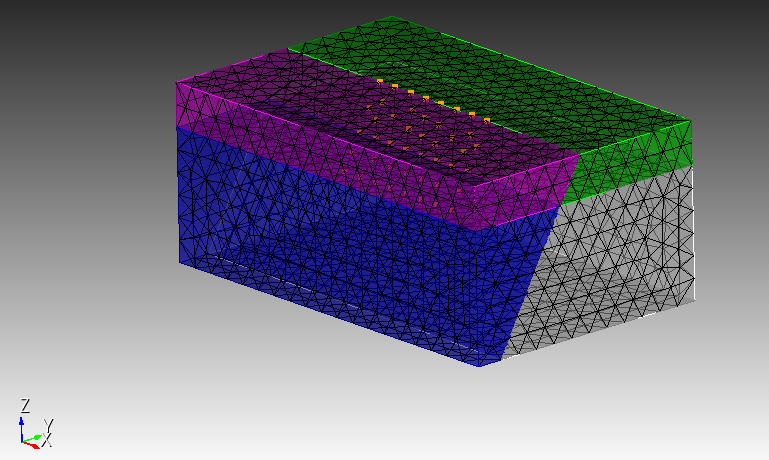
Figure 1. Example mesh for the Seattle Fault. Nodes along the fault are highlighted in orange. The purple and green volumes are assigned to the elastic material block, and the blue and white volumes are assigned to the viscoelastic material block.
Results
The generalized script was run in a loop for a series of 15 faults in the Puget Sound region, producing a set of meshes for PyLith simulations.
Automating the classification process removed the need to manually copy and assign surface and edge signatures when creating or revising each fault model.
Conclusion
Coreform Cubit’s scripting capabilities allowed Pearson to turn an example meshing script into a reusable workflow for different fault geometries. Automating mesh generation and boundary labeling reduced repetitive model-preparation work, supporting the project’s investigation of how glacial retreat may influence fault stresses and earthquake slip in the Puget Sound region.
Reference
Aagaard, B., M. Knepley, C. Williams (2025a). PyLith v5.0.0. Davis, CA: Computational Infrastructure of Geodynamics. DOI: 10.5281/zenodo.14635926.