Example 2. Interlocking rings
The following example is composed of two rings of constant cross-section that can be swept along their axes. The problem here is that the rings overlap, forming a tetrahedral shape which cannot be swept. The key to solving this problem is separating out the region of overlap, explicitly setting the source and target surfaces, and using the tetprimitive scheme on the tetrahedral region.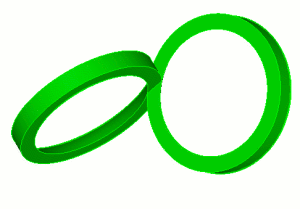
Suggested webcuts
| Webcut | Command |
 |
CUBIT> webcut body 1 plane surface 5 |
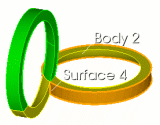 |
CUBIT> webcut body 2 sheet extended from surface 4 |
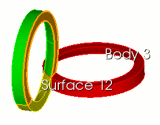 |
CUBIT> webcut body 3 plane surface 12 |
 |
CUBIT> webcut body 4 sheet extended from surface 10 |
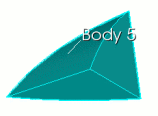
There are five volumes that result from the webcutting. Two of them are automatically sweepable. Two of them must have their schemes set explicitly, and one of them is meshed using the tetprimitive scheme.
| Webcut | Command |
 |
One-to-one Sweepable Source and target are set automatically using autoscheme CUBIT> volume 1 3 scheme auto |
 |
One-to-one Sweepable Must have source and target set explicitly CUBIT> volume 2 scheme sweep source 17 target 7 |
|
|
Non-sweepable Use the tetprimitive scheme CUBIT> curve in volume 5 interval 6 |
Final mesh
The final mesh is created at a size of 0.5 for all volumes.
