Example 1. Sweeping multiple adjacent volumes
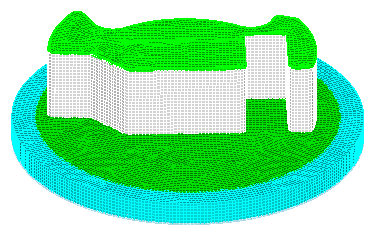
The following model has several interior volumes which share surfaces. This example may at first seem complex, but it actually requires very little decomposition. The key to this example is that each of the interior volumes is already sweepable, oriented along the same sweep axis, and none of the linking surfaces have additional topology introduced through imprint/merge. In fact, there is only one required webcut to make this model automatically sweepable.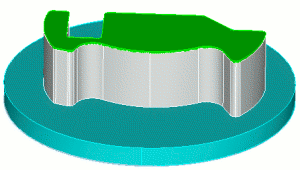
Figure 1. Exterior view

Figure 2. Interior view
We examine several of the volumes below.| Source Surface(s) | Target Surface(s) | Sweep type |
 |
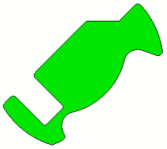 |
Many-to-one Sweepable Imprinting and merging adjacent volumes creates additional partitions on the source surface, but the target surface does not contain imprints. |
 |
 |
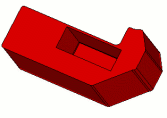
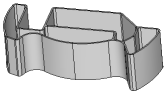
Many-to-one Sweepable Multiple source surfaces due to interior void |
 |
 |
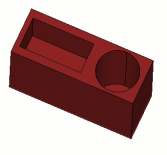
One-to-One Sweepable Source and target surfaces are single surfaces, and there are no imprints on the linking surfaces |
 |
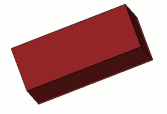 |
Many-to-one Sweepable Interior void causes multiple source surfaces. |
 |
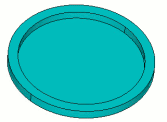 |
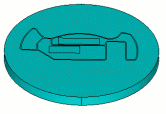
Multisweep Imprinting causes multiple source surfaces and interior void causes multiple target surfaces. This volume requires decomposition |
Suggested webcut
| Webcut | Command |
 |
CUBIT> webcut volume 5 with sheet extended from surface 70 CUBIT> imprint all CUBIT> merge all CUBIT> volume all size 0.15 CUBIT> volume all scheme auto |
Final mesh
The final mesh is created at a size of 0.15 for all volumes.