Meshing Tools
The meshing power tool provides a tool for determining whether a geometry can be meshed using autoscheme, or if it requires its scheme to be set explicitly. This tool is designed to help guide users through geometry decomposition process by providing a convenient way to see which geometries need further modification or decomposition prior to meshing.
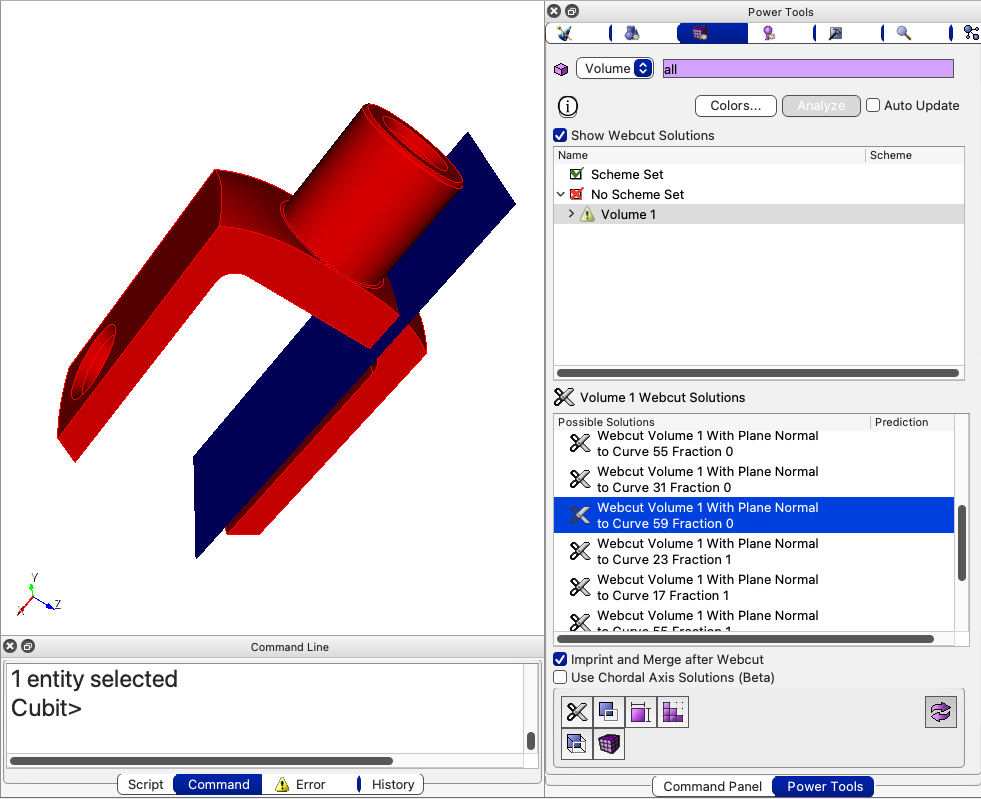
Figure 1. Meshing Power Tool showing the solution window with a preview of a webcut solution.
Entity Specification- The meshing power tool works for volumes or surfaces.
Colors Button - Opens the Tools>Options dialog to change the visualization colors of surface schemes for the meshing tool
Show Webcut Solutions - When selected the webcut solutions window will be displayed and populated with custom webcut solutions based on the selected volume.
Analyze Button - The Analyze button issues the autoscheme command for all selected volumes and surfaces and populates a two lists: Scheme Set and No Scheme Set.
Auto Update Checkbox - Used with the webcut solutions, when selected, after executing a webcut, the model will automatically update to determine meshability of the active volumes.
Output Tree - The output from the meshing tool is displayed in tree format. Geometry is divided into "Scheme Set" and "Scheme Not Set" divisions. The geometry is listed under these nodes. If autoscheme was successful, its assigned scheme is also displayed.
Solutions Window - A solutions window that displays potential webcuts for a selected volume is also available. Display the solutions window by selecting the Show Webcut Solutions checkbox at the top of the panel. When a volume is selected, a list of potential webcuts will be displayed. The solutions can be previewed by selecting them and double-clicking will execute the webcut. To further customize the webcut, a right-click on the solution will provide access to the relevant webcut command panel, pre-populated with necessary parameters.
Imprint and Merge After Webcut Checkbox - Available when the Solutions window is displayed, when selected, the resulting webcut operations will also perform an imprint and merge operation.
Toggle Visibility Button - The meshing tool displays entities as red or green in the graphics window. Green means that they are currently meshable using the autoscheme. Red means that they require their scheme to be set explicitly. Turning this capability off will return the volumes and surfaces to their original colors.
Meshing Tools Buttons - Several meshing tools are available to the user from this window. Depending on the entity selected, these are also available from the right-click context menu, and they are described below.
Right Click Context Menu
- Zoom To - Zoom in on this element in the graphics window
- Draw - Draw this entity by itself in the graphics window
- Locate - Locates and labels entity in the graphics window
- Rotate About - Issues Rotate about command for selected entity
- Visibility On/Off - Toggle visibility
- Reset Graphics- Reset graphics display
- Set Size - Opens the Mesh/Entity/Interval panel on the control panel where you can set interval sizes for the selected geometry
- Set Scheme - Opens the Mesh/Entity/Mesh panel on the control panel where you can set a scheme for the selected entities
- Set Vertex Type - Available when surfaces are selected. Opens the Mesh/Surface/Mesh panel to set vertex types.
- Imprint/Merge- Opens the Geometry/Entity/Merge panel on the control panel. If you have entities selected in the tree window it will input them to the imprint/merge command.
- Webcut - Opens the Geometry/Volume/Webcut panel on the control panel. If a volume is selected in the meshing tool window it will input it in the webcut panel.
- Color Surfaces - Color surfaces based on their schemes. You can change the default colors by selecting the Options button.
- Restore Colors - Restores colors on selected entity or entity type
- Mesh - Meshes the selected entities (bypassing control panel)
- Delete Mesh - Deletes the mesh on selected entities
- Unmerge - Unmerges selected entities
- View Descendants - Opens a list of child entities and their meshing schemes. Press Analyze to return.
- View Ancestors- Opens a list of parent entities and their meshing schemes. Press Analyze to return.
- View Neighbors- Opens a list of bordering entities and their meshing schemes. Press Analyze to return.